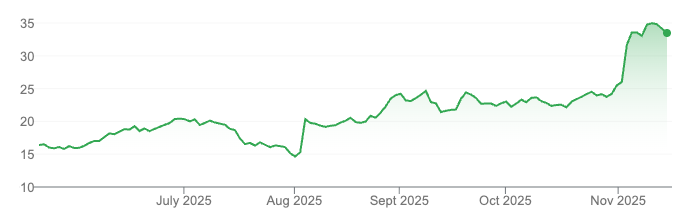
The last few weeks have been some of the most important I can remember.
The first phase of the AI boom ran from December 2022 to December 2024.
We’ve decisively entered a new phase where everything is up for grabs again, and the winners of the first will not necessarily be the winners of the second.
The latest models have to be used to be believed. Don’t take my word for it.
Tobi Lutke, Shopify founder has shipped more in three weeks than in ten years:

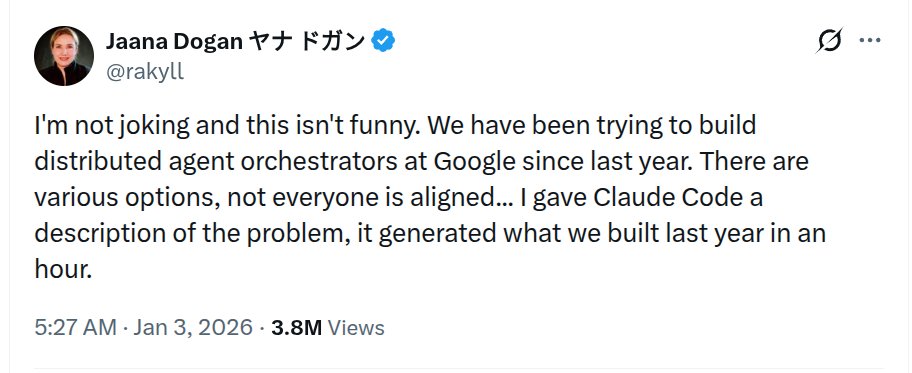
A Google engineer did a year’s work in an hour:
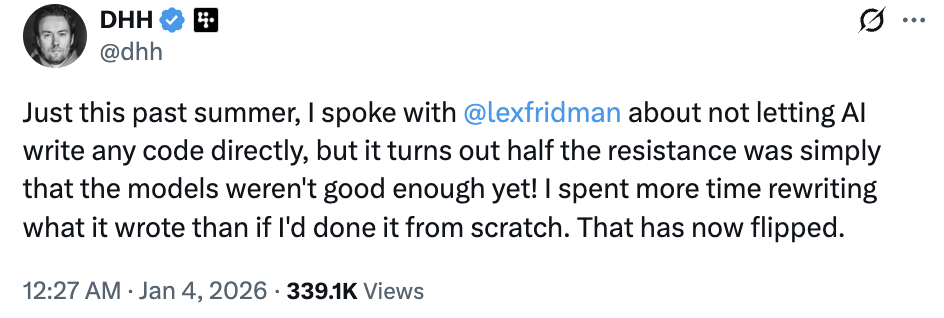
And this essay written by the founder of Ruby on Rails is worth reading in full. He was relatively sceptical until this latest release:
But even better, go to Replit and ask it to replicate an app you use, and click Publish.
For the first time models can take large, complex code bases and make requested changes across all the files - and it works. But that’s only part of the leap forward.
It’s now straightforward to conduct swarms of AI agents working in parallel, with the main limit being energy and motivation. And it’s cheap too - I’ve been running multiple projects in parallel (cancelled two major software subscriptions) and I haven’t hit the rate limit. And that’s before the next generation of chips and this year’s supply comes online.
On the investment side, I suspect this will be on of those times where the obvious trades are the best. We’ve bought more domains than ever. My personal GPU usage is easily 10-100x more than it was only a few weeks ago.
That’s not just more compute, energy, datacenter capacity, but more network traffic, and almost certainly a higher ad spend, which is particularly relevant for major tech indices with their heavy weightings to Meta and Google.
There will be immense competition for everything digital. Everywhere you look there is opportunity and threat.
In surfing, there’s a saying that the safest place is in the barrel. Right now, the safest place is at the leading edge.
We’re finally building our own Bloomberg terminal – taking the best of Bloomberg, Finviz, and the soon-to-be-deprecated Sentieo.
On the weekend I built a front end for one of our agency apps, Corner Coach. It’s not perfect, but this would have been a serious piece of work and frankly, far beyond my coding abilities, only last year. (I’ll be fighting someone at the launch, so if you want to see me get punched in the face come along!).
The new coding paradigm is rapidly moving to the terminal and thin layers on top of it. It will be the foundational models that will do most of the work. Codebases (and websites) will all have files for LLMs to efficiently parse.
There were clear winners in the first AI boom, now it’s all up for grabs again.
Many of the richly valued wrappers focused on law, medicine, and the like will have to fight hundreds of new competitors this year, which will be able to vastly outperform last year’s carefully post-trained models using publicly available APIs.
That outperformance will come where it matters most: reliability, as it won’t be one model generation solutions, but a large team of them checking and reviewing.
And this is the worst these models will ever be.
Nvidia’s latest generation of GPUs hasn’t even rolled out yet, so AI is not just about to get a lot better, but a lot cheaper too. And if the past is any guide, within six months there will be free and open-weight versions of today’s LLMs.
The rapid feedback loop is extremely addictive. For me, watching these apps get built in real time is a bigger hit than anything the social media platforms cooked up, and I know I’m not the only one.
The buzz reminds me of the various waves of crypto, only this time instead of promoting and gambling on what mostly became worthless coins, every single business model is going to tested and probed by new competition from hundreds of different angles.
Billion-dollar SAAS companies are being replicated with single shot prompts.
The hard part of business has not changed – business has been and always will be about finding customers. But this next generation can help too.
It’s straightforward now to ask an AI to find every person in an industry, assess their suitability, find their details, email them, and start a sales process. Orchestrating this across an entire industry is now a one person job.
Claude can generate hundreds (and why stop there) of different lines of text, generate a similar number of videos copying the latest viral trends, and post them across Facebook, Google, Twitter, Reddit, Tik Tok. Spend can then be allocated to the best performers automatically, the kind of work that was possible but expensive until late last year.
Content can be shared with hundreds or thousands of creators for small sums, and an army of people getting 1-25,000 views can add up to millions.
Along with software, everyone in that industry is going to have to rapidly move to the frontier. It’s safest in the barrel.
And this is only the obvious things.
The idea around a singularity was that we would reach a point where AI could improve itself. That is now happening at speed and Claude Code engineers are no longer writing code, they’re using their tool to improve itself. Perhaps the very largest codebases may still be out of reach (though I suspect within these firms there are models far more capable than what’s released publicly), but this gap will fall soon too.
This is really a Gutenberg moment, and we are living in it right now, day by day.
The printing press slashed the cost of sharing information, which was limited by the rate at which a very small community of scribes could copy texts by hand. Annual literary output jumped from thousands to millions in a generation. Before that revolution, it took 2-3 years to copy a bible.
All future science and technology depended on this moment, but the social, economic and political consequences were unpredictable. Pamphleteering became the main tool of the heretic, rebel and revolutionary. Arguably it triggered hundreds of years or religious warfare across Europe, and civil wars in traditionally stable countries like England.
The hallucination problem existed then too, and all kinds of nonsense was written. It also changed what kinds of knowledge could be written and shared, like newspapers, scientific journals, and novels. Whole new jobs were created and new political powers were unleashed.
It’s going to happen much faster this time around.
Of course many things won’t change at all. Many industries outside of knowledge work may be largely unscathed, notably healthcare and construction, but beware the God of the Gaps.
The scythe will fall hard on my own industry, finance. Already huge sums are harvested from the market by quantitative firms, to the detriment of discretionary investors. We will have to make sure our own tooling is at the leading edge, which fortunately is now more accessible than ever.
To fund managers, the question is what precisely is your strategy? Can you articulate it well enough for a super intelligence to understand? And if not, why not?
It’s an exciting, exhilarating, and scary time.
It’s safest in the barrel.